
Ceramic Dinnerware Manufacturing
Ceramic Tableware
Production
From clay preparation to glaze firing: 7 steps that transform a lump of earth into a piece of tableware that lasts for decades.

The potter's wheel – the oldest tool in ceramic production, still indispensable.
The production of ceramic tableware is a process that takes time. From raw clay to the finished plate, at least two, often three, weeks pass in a artisanal workshop. Each step depends on the previous one – if one is skipped or shortened, it will show in the result.
True craftsmanship takes the time it needs. A plate that lasts 20 years takes three weeks to produce.
How is ceramic tableware made – step by step?
The production of handmade ceramic tableware follows a fixed sequence of seven steps. Each step is dependent on the previous one – no piece moves on before the current step is fully completed.
The raw clay is mixed with water, kneaded, and freed from air pockets. Air bubbles would cause the piece to burst during firing. An experienced potter feels the right consistency – too wet, too dry, or uneven means starting over.
The shape is created on the potter's wheel, by hand-forming, or by casting. For plates and bowls, throwing is usually used – the wall thickness must be kept uniformly at 4–6 mm. This precision requires years of practice.
The shaped piece dries for several days at room temperature – until it reaches "leather hard" stage. In this state, it can still be reworked: trimming the foot, attaching handles, smoothing surfaces. Too rapid drying leads to cracks.
In the first firing process at approx. 950 °C, the piece becomes stable, porous ceramic. Bisque firing takes 8–10 hours in the kiln, followed by at least 12 hours of cooling. Opening the kiln too quickly would destroy all pieces due to thermal shock.
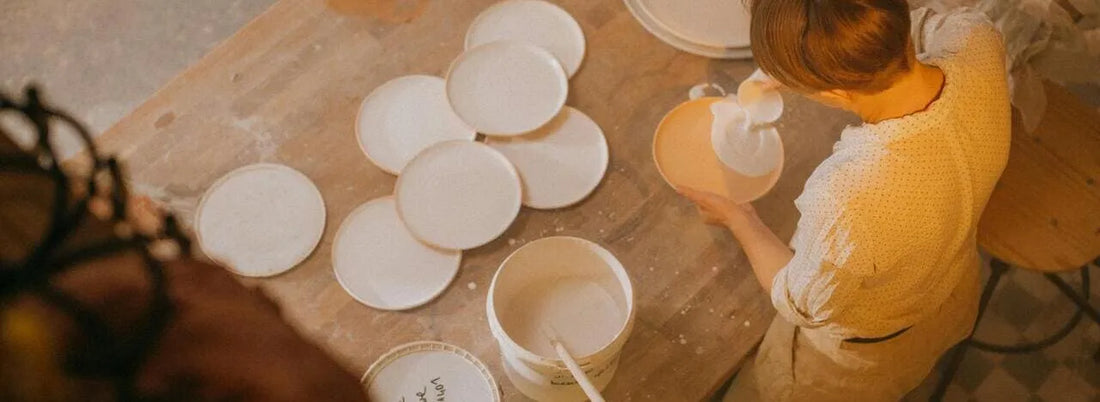
The reactive glaze is applied by dipping, pouring, or brushing. Multiple layers on top of each other enhance the chemical reaction in the next firing. Each manufactory has its own glaze recipe – knowledge passed down through generations.
The crucial step: 8–12 hours at over 1,200 °C. The glaze melts, flows, reacts with the clay and the kiln air. What exactly emerges is decided by the kiln – not the potter. This is followed by another 12 hours of cooling.
Each piece is individually inspected: cracks, irregularities, dimensional deviations. Color variations due to the reactive glaze are not defects – they are the hallmark of genuine handwork. Töpferkunst checks every piece before shipping.
What type of clay is used for high-quality ceramic tableware?
Stoneware clay is used for high-quality everyday tableware. It contains natural minerals – iron oxide, feldspar, quartz – which give the finished piece its weight, stability, and earthy character. These minerals are also why reactive glazes produce such vibrant patterns on stoneware clay.
Porcelain clay (kaolin) is pure white and produces fine, translucent tableware. Stoneware clay contains natural impurities – which makes it more robust, heavier, and suitable for reactive glazes. For handmade everyday tableware, stoneware clay is the superior choice.

Stoneware clay (left) contains natural minerals that make reactive glazes possible.
Töpferkunst works with manufactories that carry out this process in its traditional form. The tableware in the dinnerware sets is the result of weeks of skilled craftsmanship. Discover all collections in the assortment.
Frequently asked
questions
Ceramic tableware is made in seven steps: clay preparation, shaping on the potter's wheel, drying to leather hard, bisque firing at approx. 950 °C, applying glaze, glaze firing at over 1,200 °C, quality control. For handmade tableware, each step is performed under direct artisanal supervision.
Bisque firing (approx. 950 °C) hardens the raw clay into a stable, porous biscuit. Glaze firing (over 1,200 °C for stoneware) fuses the glaze and the biscuit into an indissoluble unit – the result is waterproof, food-safe, dishwasher-safe tableware.
From clay preparation to the finished plate, at least 2–3 weeks pass in an artisanal workshop. Drying alone takes several days. Each firing process takes 8–12 hours in the kiln plus 12 hours of cooling. This is the price of genuine craftsmanship.
Stoneware clay is used for high-quality everyday tableware – a natural clay that contains iron oxide, feldspar, and other minerals. Stoneware clay is fully vitrified at over 1,200 °C – the result is dense, robust, and impermeable to water.
The result of weeks of craftsmanship
Töpferkunst tableware is created in manufactories that perform each of these seven steps using the same techniques for generations – at over 1,200 °C.